Nobody Wants Water Works
No other plant binds so tightly to humankind as wheat. I’ll come back to that. But first I want to talk about a board game.
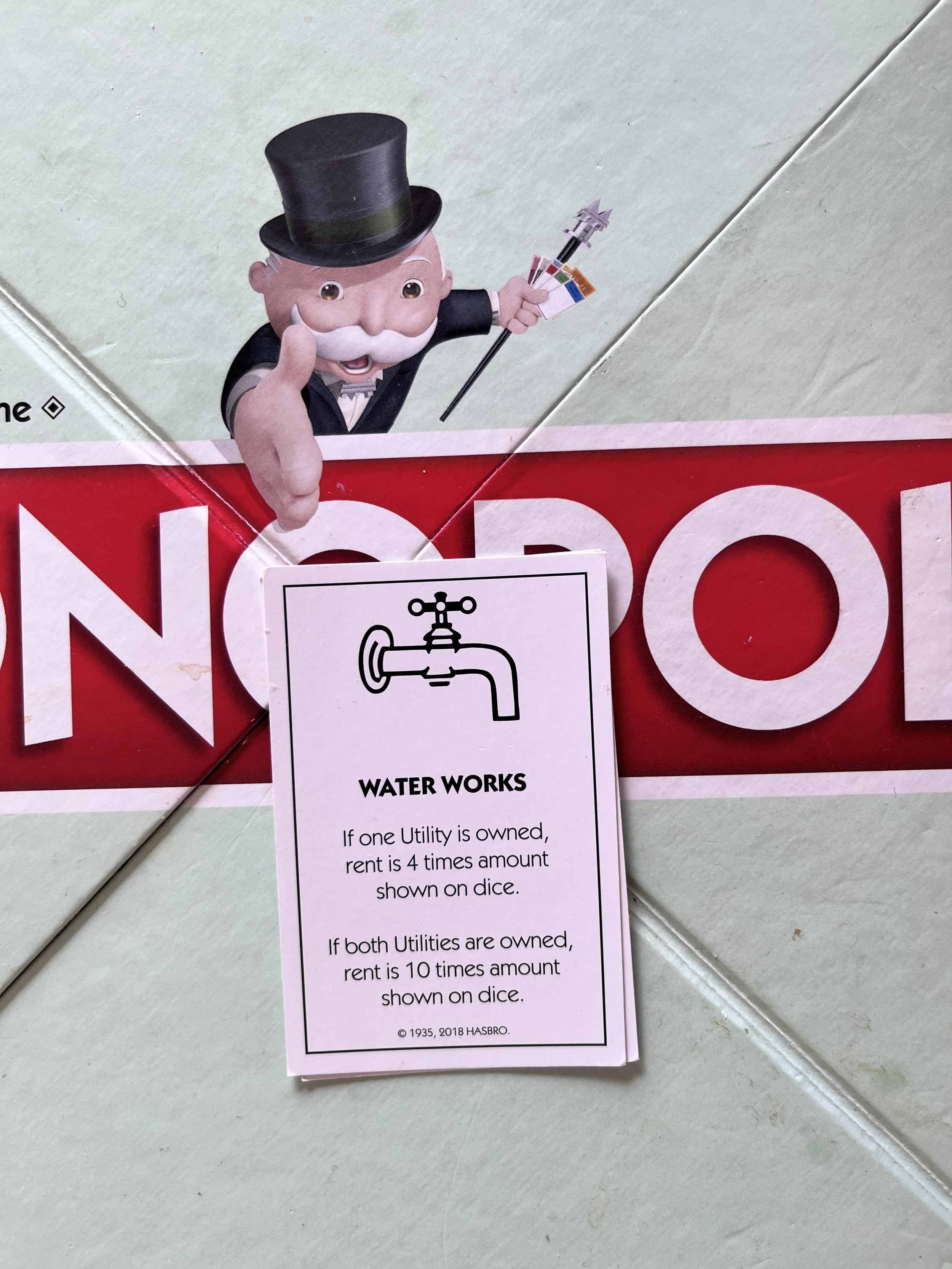
There’s a card in Monopoly nobody wants. Water Works. It costs you £150 and it earns you nothing much — four times the dice if you own one utility, ten times if you own both. Land on it with a bad roll and the owner gets eight pounds. It’s a joke card. Experienced players skip it and save their money for the orange set.
Here is the thing that has been sitting with me. In the real game, Water Works is the best card on the board.
England and Wales sold their water in 1989 for about £6.1 billion. The companies were handed over with no debt at all, plus a sweetener of public money on the way out the door. Since then the industry has paid out around £72 billion in dividends to shareholders — the Financial Times, adjusting for inflation, put the figure nearer £78 billion. Over the same period the companies have taken on roughly £60 billion of debt they didn’t have when we owned them. Bills have gone up around 40 per cent in real terms. No new reservoirs. Two and a half billion litres a day lost to leaks.
Four times the dice. Ten times the dice. Not even close.
The river
I live and work in Devon, and this isn’t abstract here. People swim in the Dart. People have got sick swimming in the Dart. You have to go a long way up — past Holne, up towards the moor — before you’re in water you’d put a child in without thinking twice. Down at the estuary the sea has a scum on it in the wrong week and everybody knows what it is and nobody says it out loud.
What’s remarkable is what it took to get anyone to even measure it. Friends of the Dart, a community group, spent years counting swimmers, running their own lab tests, gathering thousands of letters of support, working with Surfers Against Sewage, in order to win designated bathing water status for four sites on the river. They got it. It’s the most sites any river in the country has been granted. And what it means, in the end, is that the Environment Agency now has to test the water and tell us how bad it is.
Volunteers did that. Not the company that has been paid, every month, by every household on that river, for thirty-seven years.
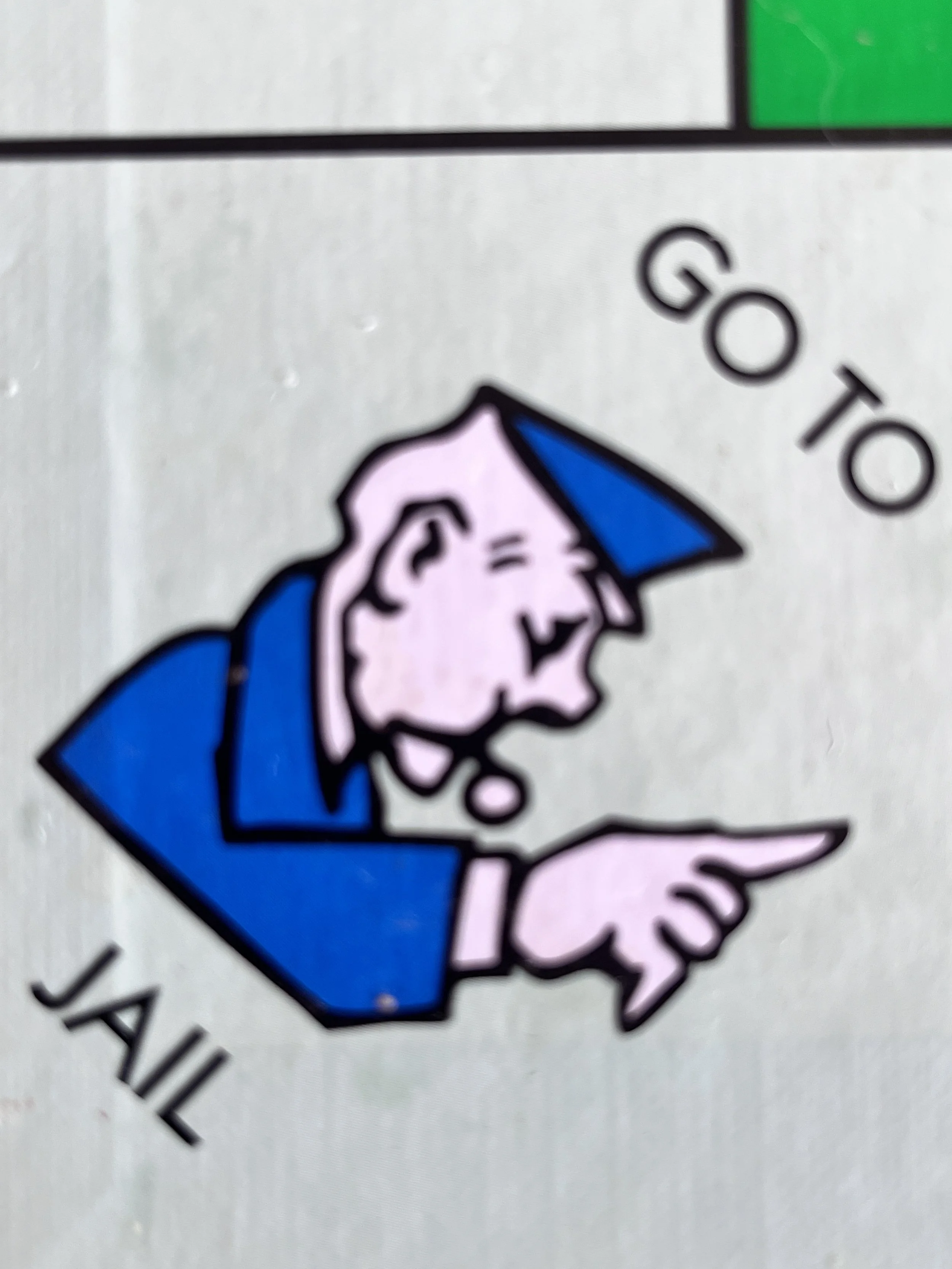
Go to Jail
The second card. The one with the old man in the top hat pointing you off the board.
Nobody goes. There have been fines, sanctions, select committees, a Special Measures Act, a great deal of shouting. Two-thirds of England’s water companies have employed senior people who used to work at the regulator. Ofwat’s former chief executive went to a directorship at Thames Water. The regulator is now being abolished — not for being too harsh, but for failing to do the job — and folded into a new super-regulator, which will presumably need staff, who will presumably come from somewhere.
But here’s the detail that I keep turning over.
When the government commissioned Sir Jon Cunliffe to run the largest review of the water industry since privatisation — 88 recommendations, a “fundamental reset” — the terms of reference specifically excluded public ownership. It wasn’t considered and rejected. It was ruled out before the panel sat down.
They took the card off the board before anybody rolled.
Super Tax: pay £100
The third card is the ring. Pay £100. It’s the small, dull, unavoidable one — the card for people who don’t own anything, who just go round and round the outside of the board collecting a wage and paying out.
Bills in England are set to rise substantially over the next five years, to fund the investment that should have been made with the £72 billion. That’s the arrangement. The dividends went out, the debt came in, the debt service goes on your bill, and the interest is tax-deductible — which is to say, subsidised by you a second time.
You pay £100. You pass Go. You pay £100 again.
The part nobody tells you about the game
Monopoly was not invented by a man in the Depression who got rich off it. That’s the story Parker Brothers sold, and it isn’t true.
It was invented in 1903 by a woman called Lizzie Magie. She was a Georgist — a follower of Henry George, who argued that people should own what they make, but that land and nature belong to everybody. She called it The Landlord’s Game, and she designed it as a teaching tool: a practical demonstration, she said, of land-grabbing and where it leads. Her patent already had the loop of squares, the wages for passing the start, the railroads, the Go to Jail corner, and a Public Park where Free Parking now sits.
And it had two sets of rules.
There was the Monopolist ruleset, which is the one you know — you win by bankrupting everybody else. And there was the Prosperity ruleset, in which everyone gains when wealth is created, and the game ends when the poorest player has doubled what they started with.
Same board. Same dice. Same properties. Completely different definition of winning.
The Prosperity rules did not lose a fair fight. They didn’t fail on the merits. When Parker Brothers bought the game from Charles Darrow in 1935 and found Magie’s prior patent standing in the way, they paid her five hundred dollars, no royalties, and marketed Darrow as the inventor. The anti-monopoly game was quietly monopolised. The alternative ruleset went in a drawer.
I don’t think I’ve ever come across a cleaner picture of how this actually works. The alternative isn’t missing because it was tried and found wanting. It’s missing because somebody bought it and shelved it, and then two or three generations grew up assuming the rules on the box are the only rules there are.
And there’s a detail people miss when they use this metaphor. They say: there’s water on the board, there’s electricity, there are the railways, but there’s no food. There is. The board is land. That’s what Magie was teaching, and it’s Henry George’s whole argument — that people should own what they make, but what nature provides belongs to everybody. Mayfair and Old Kent Road and a wheat field outside Buckfastleigh are the same asset class. Food isn’t a missing square. Food is what the squares do.
What nobody in 1903 had worked out how to own was the middle — the bit between the field and the mouth. That’s what’s being bought now.
So how do people let it happen?
I’ve been asking this badly. I’ve been asking: how can working people watch this so obviously and not stop it?
But that question quietly blames the wrong people, and it isn’t even accurate. You cannot boycott water. There is no second tap. There is no competing pipe, and there was never meant to be — the companies were sold as regional monopolies with captive customers, which is the entire reason the model prints money. You can’t switch, you can’t refuse, you can’t opt out, and the one lever that might have worked was ruled out of a review before it started. Meanwhile most of the ownership sits with foreign pension funds, infrastructure vehicles and sovereign wealth funds — which means, strange as it sounds, that some of England’s water is now effectively owned by other governments, just not this one.
That isn’t consent. It’s captivity. It isn’t apathy — it’s the absence of a lever.
Which is precisely why we work on food.
Where the lever still is
Food is the one essential system where ordinary people still hold the dice. You can’t choose your water company. You can choose where your flour comes from. And more than choose — you can own the means of making it.
Wheat is where I’d start, and not for sentimental reasons. It’s twenty to thirty per cent of the British diet by calories. It’s one of the three crops the world runs on, and the only one of them we can grow properly here. About a third of everything on a supermarket shelf has flour in it somewhere.
And it’s already being played the Monopolist way, out loud, right now. England has lost around 36,000 agricultural holdings since 2005 — one in seven. Since 2021 closures have outpaced new farms every single quarter; for every ten farms that shut, fewer than six are replaced. Roughly nine per cent of England’s highest-output farms now produce over sixty per cent of the country’s agricultural output. Fewer players, bigger holdings, houses going up. That is the endgame of Monopoly described in Defra statistics.
Milling has gone the same way. Around thirty-two companies mill flour in this country, but the four largest account for roughly sixty-five per cent of production. In organic — which is the number that matters to me, not the reassuring national one — somewhere between forty and sixty per cent of the grain comes off the global commodity market: Kazakhstan, Ukraine, Canada. Canadian wheat milled in Italy and sold back to us as pizza flour. That is a colonial supply chain with a nice bag design.
The bit the policy conversations keep missing is processing. There’s a great deal of good work on farming and a great deal on retail, and almost nothing on the middle. You can regenerate every acre in Devon and if the grain still leaves for a mill owned by an asset manager, the power hasn’t moved an inch. We can’t change the system using the system. Mid-scale processing has been quietly decommissioned over fifty years — there’s home scale and there’s industrial scale and there’s nothing in between.
People will tell you a town can still have a bakery, and it can. That’s exactly what makes it deceptive. The building is local. The oven is local. The baker knows your name. And the flour came off a ship. The last piece of local food infrastructure most towns still have is, structurally, a retail outlet for the global commodity market. The high street looks intact and the supply chain behind the shopfront runs to Kazakhstan and Ukraine, or to Canada by way of a mill in Italy, arriving as pizza flour that was grown four and a half thousand miles from the table it ends up on.
So it isn’t quite that the mid-scale is gone. It’s that where it survives, it’s been hollowed out and re-plumbed into somebody else’s system. The bakery is a franchise that doesn’t know it’s a franchise.
The same thing happened to us socially, and I think it’s the same event rather than a parallel one. Community in this country wasn’t a mood, it was infrastructure: council housing, union branches, working men’s clubs, markets, the mid-sized local employer where four hundred people knew each other’s names. All of it decommissioned inside two generations. Home scale and industrial scale, nothing in between — in bread and in belonging. A town can have a food bank. It can’t easily have a place where four hundred people converge.
That gap is the opportunity. But there’s a second half to it, and it’s the part I’ve under-explained for years.
Flour is the Water Works card
Here’s the thing about the utilities. Even when you own them, they don’t pay. In Monopoly nobody gets rich on a single square — the money is in a completed set with houses on it. One property is a rounding error. Three of the same colour with buildings is the whole game.
Flour on its own is the Water Works card.
I know this because I’ve played it. The first time round I milled organic, non-organic, heritage, ancient — and sold flour to bakeries, because the consumer market didn’t look big enough to be worth the time. What happened is what always happens: I commoditised my own flour and sold it at a loss. Beautiful grain from named farms, ground on stone, priced against a sack from a mill turning out ten thousand tonnes a week. You cannot win that. Nobody can win that. It’s four times the dice.
The economics only come alive when the grain keeps moving. Mill it, then make something with it. Pasta. Crackers. Biscuits. Noodles. Bread out of the oven at eight in the morning and a pizza out of it at seven at night.
That isn’t glitter on top of the real business — it is the business, and here’s the arithmetic. We pay our farmers over a pound a kilo, which is a real price, an unarguable price, the price they asked for. Sold as flour, that grain leaves with almost nothing added and almost nothing kept. Turned into a plate of pasta, the same wheat costs one to two pounds to put on a table and sells for six to eight — and every step of that uplift happens within a few miles of the field, in a building owned by the people doing the work.
That’s not a margin. That’s the mechanism. It’s the difference between a community that grows wheat and a community that keeps the value of its wheat. Added value is how you pay a farmer properly without charging a family a fortune, and it’s the only way I know to do both at once.
Two buildings
Which is why this ends up being about premises, and why there are two versions of it.
On the farm. Grain in the back end, pasta out the front. The mill, the drying room and the kitchen sitting a hundred metres from the crop, and a room where people eat it. You arrive, you look at the field, you look at the mill, you sit down and you eat what you just looked at. No supply chain to explain, because you can see the whole thing.
On the high street. The same logic dropped into a town. Milling visible through glass by day — flour, bread, pastries — and the room turns over in the evening for pasta and pizza. A working mill that is also a shop that is also somewhere to eat, in a building the town already owns or has left empty. There are abandoned churches and dead retail units in every market town in this country, and there is a government, and there are landlords, and there is a church, all of whom could put a mill in one tomorrow.
Neither of those is a café with a bag of flour in the window. The making is the point. Take the added value out and you’ve got a nice heritage attraction that doesn’t wash its face. Leave it in, and you’ve got a business that pays its farmers, pays its workers, feeds its town at a price its town can afford, and can be built again forty miles away by people who’ve never met you.
Playing the Prosperity rules
What we’re building at Fresh Flour is not complicated, and it isn’t new. It’s Magie’s other ruleset, applied to grain.
A working mill, owned by the people who operate it. Grain from named farms, at the price the farmer asks — not the price we can push them to. Milling and making kept local, where the intuition and the relationships live, with the boring shared machinery — sales, admin, contracts, safety — handled centrally, the way Mondragon has done it for seventy years. Community supported milling. A mill in every town that wants one, in buildings we already collectively own, making what that place is good at.
And the same product at two prices: premium where people can pay it, wholesale where they can’t, so that good food isn’t a class marker.
The measure of whether it’s working isn’t how much we take out. It’s Magie’s win condition — and note what it actually is. Not everybody equal. A floor. The game ends when the person with the least has doubled what they started with. That’s a far harder thing to argue against than equality, and it’s the number I’d want us judged on.
I should be clear about ownership, because this is where people hear what they expect rather than what’s said. I’m not arguing for state-owned capitalism — for a national grain board, or for the same extractive machine with a minister on top of it. But nor am I letting the water companies off.
The distinction is structural. Water is one pipe network. It is a natural monopoly; it can only ever have a single owner, which is precisely why selling it was a category error, and precisely why that owner has to be the public. Food isn’t a network. It’s thousands of small acts of growing, milling, making and feeding — so it should have thousands of owners. One system needs one public owner. The other needs as many private, local, common hands on it as we can possibly get. Different structures, different answers, same principle underneath: the thing everybody needs shouldn’t pay rent to somebody who doesn’t.
The honest bit
None of this fixes the river. I want to be straightforward about that, because I don’t like arguments that promise more than they can carry. Milling good wheat in Buckfastleigh will not clean the Dart, and the people doing the water testing and the legal work and the sewage campaigning are doing something we are not doing and should be supported in it.
What food offers isn’t a substitute for that fight. It’s a place where the same fight can actually be won — at a scale small enough to start on a Monday, and repeatable enough to matter. Every mill that gets built and held in common is a working demonstration that the other ruleset exists and functions. That’s not nothing. That’s the thing that was taken from us in 1935 and again in 1989: not the alternative itself, but the memory that there was one.
You can’t buy the water back. Not yet, not on your own.
You can eat a plate of pasta made from wheat grown up the road, milled in a building you can walk into, by people who own the place they work. And you can help put one of those on your own high street.
Same board. Same dice. Other rules.
Food is liberation. We pay farmers what they ask.