
Why Your Food Shopping Makes a Difference
A response to Claudius van Wyk and the Holos-Earth Project
Claudius, thank you for this — and for the invitation Klaus Mager's talk extends to all of us: to see food not as a commodity stream but as a living network. I want to answer from the ground. Literally.
In 2015 I grew an acre of April Bearded wheat in Devon. I scythed it, threshed it, and milled it by hand. What that year taught me was not a technique but a relationship: that a field of wheat is not a factory floor, it is a community of soil organisms, fungi, insects, weather and human attention, all metabolising sunlight together. When Stephan Harding taught me at Schumacher College that Gaia is not a metaphor but a description — that the Earth behaves as a single self-regulating living system — the acre made sense. Every loaf is a conversation with that system. The only question is whether the conversation is honest.
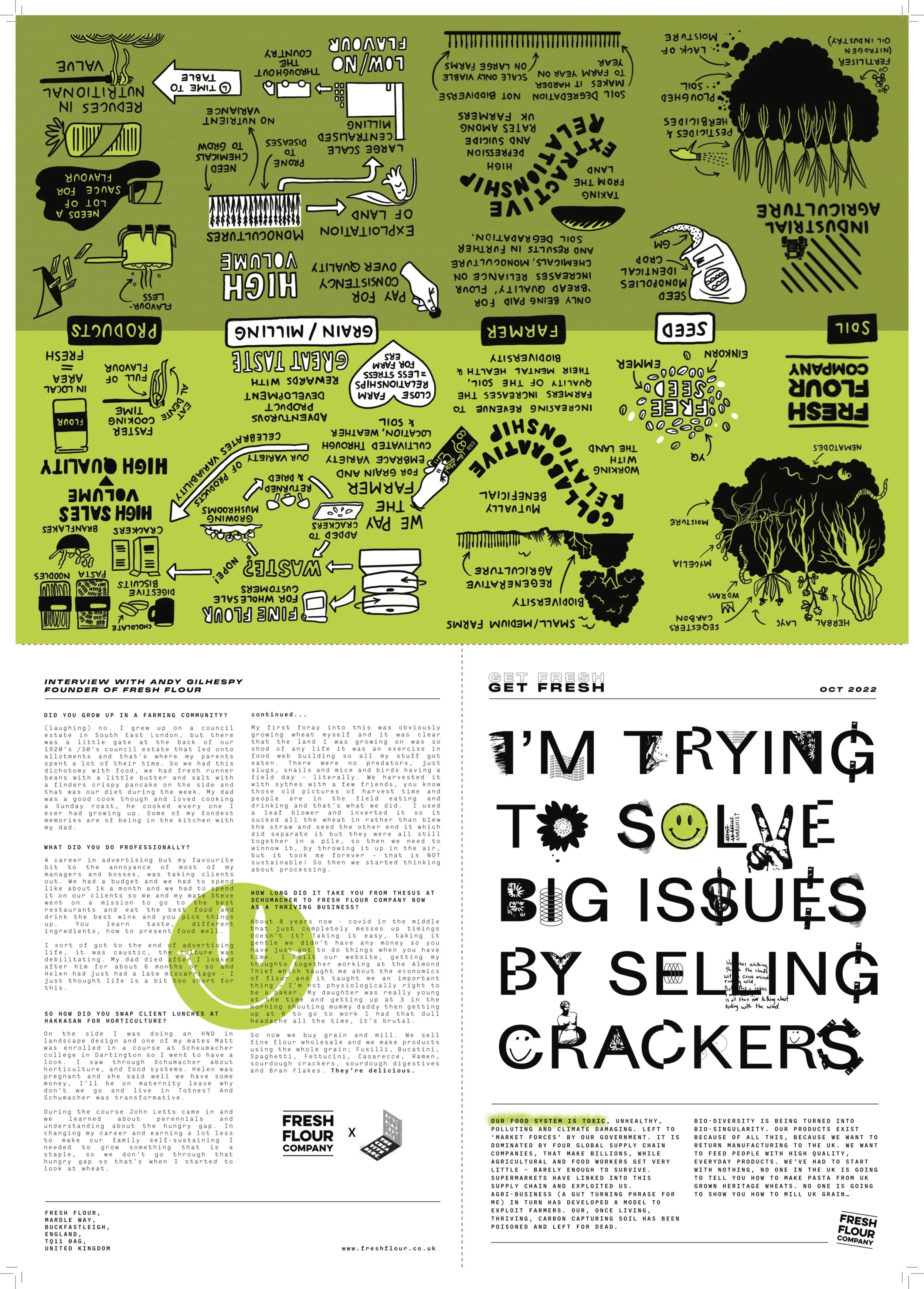
The industrial food system, as your article and Dr Turton's water work make painfully clear, is a dishonest conversation. It takes from soil, water, and nitrogen cycles without reciprocity, and it takes from farmers the same way — extracting their labour at prices set by people who will never stand in their fields. The ecological wound and the economic wound are the same wound. You cannot heal soil while impoverishing the person who tends it.
So here is our answer at Fresh Flour, and it is deliberately unheroic: make the good purchase simple.
We are a small worker-owned, not-for-profit stone mill in Buckfastleigh. We buy heritage and population wheats from named organic farms — farms you can point to on a map — and we pay farmers what they ask. Not what a commodity exchange says grain is worth. What the person who grew it says their work is worth. Then we mill it slowly on stone, whole, and turn it into flour, pasta, and biscuits that people actually want to eat. No intermediary chain of extraction between the field and your kitchen. The whole political economy of the thing fits in a sentence: we pay farmers what they ask, and you pay us for real food.
This matters because the Anthropocene will not be exited through better sentiment. It will be exited through millions of ordinary metabolic acts — meals — routed through different economic plumbing. Agroecological farming already knows how to work with living systems rather than against them; what it lacks is a market that doesn't punish it. Every time someone buys a bag of our flour instead of a roller-milled commodity blend, a real sum of money moves from an eater to a Devon farmer growing wheat in genuine diversity, and a small piece of the extractive system is defunded. That is not consumer virtue-signalling. That is participation in Gaia's economy — matter and value cycling locally, visibly, accountably.
Our longer ambition is that this shouldn't be rare. We are building the mill as a pattern, not a monopoly: a commons model of community-owned mills in rural and urban towns, worker-owned, rooted in public buildings, each one shortening the distance between a field and a family. Holism, in the end, is not an idea to be conferenced. It is a supply chain short enough to see both ends of.
So yes — register for Klaus's talk on 22 July. Rethink the system as a living network. And then, on Thursday, when you buy your flour or your bread, remember that you are not a consumer at the end of a pipeline. You are an organism inside a living system, and your purchase is a vote for which metabolism the Earth runs on.
Food is liberation. We pay farmers what they ask.
Andrew Gilhespy — Fresh Flour Company, Buckfastleigh, Devon www.freshflour.co.uk
Ready to Shift Gears?
Fill out the form, hit “Send,” and we’ll plot your first steps toward a body that keeps up with your ambition.